

22 Sep Interview with Mr. Marco Antonio Calderón de la Barca Quintanilla, Minister of Mining and Metallurgy of Bolivia
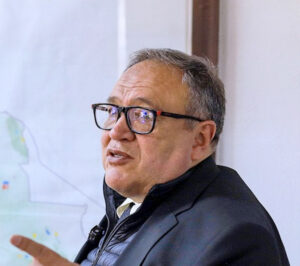
Bolivia is moving forward with the drafting of a new Mining Code, a process that has just begun this month. What changes do you consider essential in order to offer international investors a more modern, predictable and competitive regulatory framework compared with other mining countries in the region?
The most important thing, I believe, is to eliminate the “roadblock state” (Estado tranca) that we have in practically many countries of the region, to make it far more agile and far more transparent. To that end, our aim is precisely to digitize all the dealings one has with the various entities where permits must be requested. One of them, for example, is the Administrative Jurisdictional Mining Authority, the AJAM, where one applies for new mining areas in order to carry out work; this will be digitized in such a way that the contact between those who grant the areas and those who request them is eliminated. This will give us more transparency, more agility, shorter timeframes and it also removes the possibility of corruption.
One of the main objectives of the new regulation is also to strengthen legal certainty and create conditions that make it possible to attract new investment. For a foreign investor analyzing the mining opportunity in Bolivia today, what concrete guarantees can the State offer regarding the stability of the rules, mining rights and the security of their investments over the long term?
First of all, what we are trying to create is a mining code. In the mining code, unlike a mining law, we will have two books: a first book containing the substantive rules — that is, the relationship between the state and the mining operator — and a second part containing the procedures. When you have a law, that law can be regulated and the regulations are generally issued by ministerial resolution — that is, very easy to change over time. The idea is for this to be as durable as possible, so that the conditions and requirements we set are sustained over time and we do not keep adding more and more requirements. This is the part we want: to create a code with a substantive first part and a procedural second part and for it to last as long as possible without being modified.
Everything can be improved, but of course the perfect is the enemy of the good. So we believe that, in this way — with the rules being very clear and changeable only by law — no one can arbitrarily go about modifying little bits and pieces, so it would be sustainable over time. Likewise, on the tax side, we are also working on a system of incentives to bring in large investments and this incentive scheme is specific to the mining sector. There is already an investment law, on which work is also underway, with many advantages for investors from abroad. The incentive scheme specifically for mining will be there to favor any project with an investment of $50 million or more that employs more than 200 people who can benefit from it in mining. In fact, that is practically all of them, in fact, since they are larger than $50 million.
“All this technology can enable us to recover certain minerals that are companions to the major minerals. For example, tin always contains indium. There is also germanium present. If we can also recover these with European or Swiss technology — which have great expertise — or with German technology, which has great knowledge in the area of chemistry, we could earn a very important added value and in terms of the price of each of these metals that could be recovered. There are opportunities for partnerships with academia and, of course, also with European industry.”
Bolivia has significant reserves of minerals such as zinc, silver, antimony, tin, tungsten and copper, in addition to other resources considered strategic for the new global supply chains. Which do you consider currently represent the greatest opportunities for international investment and which specific projects does Bolivia want to position before European markets?
The motto of the President of Bolivia, Rodrigo Paz, is: “Bolivia to the world and the world to Bolivia.” What we are trying to promote is that we have different minerals and, of course, to bring investments to Bolivia. We have complex ores which are generally lead and zinc, with a high silver content. Bolivia is characterized by having very good silver deposits and the more silver there is, the better the deposit. We also have others, such as antimony and tungsten. But copper is something we have not exploited and in this administration we are trying to make it a very important mineral, especially given the demand, which is growing strongly with electromobility. We intend to join the Latin American team of copper producers.
How does Bolivia want to position itself within these new supply chains and what role do you think European technology, knowledge and capital, including Swiss capital, can play in the development and processing of these resources?
Switzerland is practically the first world within the first world, it has a great deal of technology, especially in the field of chemistry. This allows us to consider adding greater value to some of the minerals we have, especially when we think about concentration, purification and solvent extraction. All this technology can enable us to recover certain minerals that are companions to the major minerals. For example, tin always contains indium. There is also germanium present. If we can also recover these with European or Swiss technology — which have great expertise — or with German technology, which has great knowledge in the area of chemistry, we could earn a very important added value and in terms of the price of each of these metals that could be recovered. There are opportunities for partnerships with academia and, of course, also with European industry.
What we seek are long-term relationships. And Europe is looking for the same. It is looking for reliable suppliers who can deliver precisely what has been committed. That is what we can do. We are looking for investors, strategic alliances and long-term. The longer, the more trust on both sides.
Bolivia has experienced historical cycles of nationalization and opening that have generated diverse and confusing perceptions among international markets. What is this administration doing differently to strengthen legal certainty and ensure that the rules applied today will remain in place over time?
One is the new investment law, which offers very significant attractions for both domestic and foreign investment, along with certain security clauses. This basically makes it very attractive to come and invest in Bolivia. We are also looking, specifically in the mining field, at an incentive scheme for the mining sector. In any case, what we are always seeking is sustainable mining that is respectful of the environment, respectful of the communities and with a very good relationship with the state.
It is not only about extracting; there also has to be the payment of duties, the payment of taxes and a very good governance relationship, which is fundamental. So all these rules are precisely what we are contemplating in the new Mining Code. We have been working very closely with the Vice-Ministry of the Environment and with the National Service of Protected Areas, which we consider fundamental in order to determine where mining can be carried out and where there is zoning. In some places they tell us the ecosystem is so fragile that there definitely cannot be any mining there. But, on the other hand, there are other places within the same protected area where — provided the protection conditions of the park or protected area are respected — mining can indeed be carried out. We are all working closely with both the Ministry and the National Service of Protected Areas.
These days there is a great emphasis on diversifying economies so as not to depend on a single sector. In Bolivia’s case, apart from mining, what other sectors do you think, from the government’s point of view, could be attractive for the people who will read this feature?
I think there is one fundamental and important point. Today, the mining sector is becoming an economic pillar, the most important one Bolivia has. But we must not neglect the agricultural side, which is also fundamental. What is more, there are many communities that are agro-livestock communities and today want to become agro-mining communities. So there comes a point when they go beyond planting: they are working on the agricultural side, but afterwards they also start working on the mining side. And with a little corporate social responsibility Peru has been able to find new products that are important in its production chain, such as blueberries, avocados or mangoes. We likewise have to look for certain market niches for some of the possibilities we have. We have enormous biodiversity in frogs, snakes and reptiles.
All of this can serve precisely through partnerships with French and Swiss laboratories, mainly, which are great developers of medicines, of new medicines. In fact, from frogs, some medicines have been made to fight diabetes and others against Parkinson’s. We all have very important things we can develop. I believe knowledge is fundamental and, by forming an alliance with producers of fragrances, aromas and medicines, we can find a new direction precisely to produce certain conifer products or some other things that may be important for the development of new medicines. I think that could be a very promising future for that agro-mining sector: not to devote itself to something traditional, but to seek something with great added value that can be linked to scientific research.
What does the Ministry expect from its potential Swiss partners in terms of investment, technology, knowledge and industrialization?
Basically, what has to be done is coordinated work. First of all, to promote Bolivia — not only the mining side, but to carry out cross-cutting work. We have been working a great deal with the United Nations Industrial Development Organization and the various programs they have and we are looking precisely at how we can achieve a lower negative impact on the environment while, at the same time, new ideas are emerging about what additional things we can do beyond mining.
We have to invest and we have to reinvent ourselves. There are indeed many people earning significant sums of money, but if they stay only in mining, well, we will miss precisely a train of opportunities to invest in knowledge and technology. So we must invest.
What would be the final message from the Ministry, from you as Minister of Mining and Metallurgy, about Bolivia and its sector, for all these people who will read the feature on Bolivia?
As I said, “Bolivia to the world and the world to Bolivia.” I think that is fundamental and important. We believe that, with good promotion, we can develop new projects. As always, we continue to work precisely on the possibility of forming an alliance with the World Bank, in order to strengthen several projects that are state-owned, managed by COMIBOL — the Mining Corporation of Bolivia. We are going to make greater investments in order to have more data to make these projects more interesting and offer them to the world so that people come to invest.
We have advantages over other countries. Do not forget that Bolivia has the Altiplano, where solar energy irradiation is fantastic. I believe it is practically between first and second place in the world for the highest solar irradiation. Therefore, any solar park there is essential. Energy is very important for data centers. It also allows you to run cooling fans, which is likewise very important for data centers. Therefore, Bolivia can be a great destination country for investment in data centers.